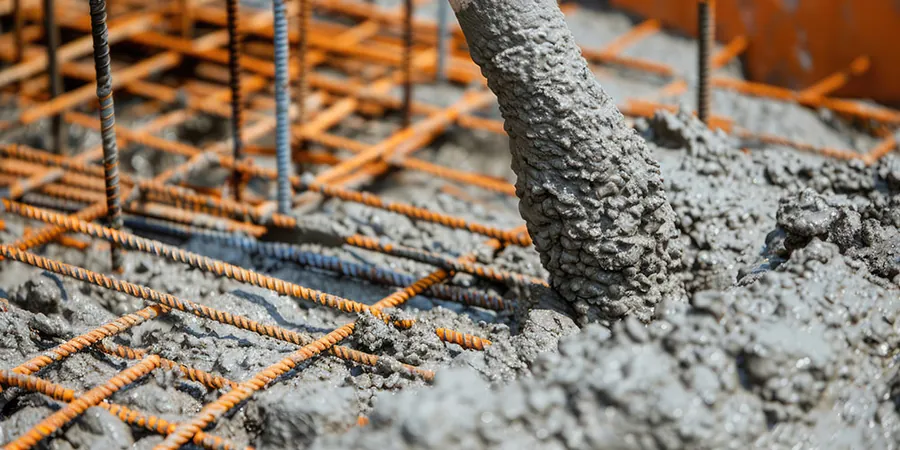
The geology beneath Wexford town shifts quickly. Within half a kilometre you can move from dense Irish Sea till derived from Cambrian metasediments to compressible alluvial clays along the Slaney estuary. That contrast means a standard 1.2 m deep strip footing that works on the north side may need a completely different approach near Crescent Quay, where groundwater sits barely a metre below ground level. Our shallow foundation design work starts with a desk study of the GSI Quaternary mapping, then moves to targeted in-situ testing to pin down allowable bearing pressures and total settlement. In many Wexford sites we combine trial pits with a CPT campaign to get continuous stratigraphy where the water table makes deep excavation impractical. The output is a set of dimensioned pad, strip, or raft foundation drawings backed by Serviceability Limit State checks under Eurocode 7 — no generic assumptions, just numbers tied to the ground you actually have.
In Wexford's till, bearing capacity is rarely the limiting factor — differential settlement across the transition from dense till to alluvium is what catches people out.
Methodology and scope
The fieldwork kit we mobilise around Wexford includes a 20-tonne CPT truck with a 200 kN penetration capacity and a mechanical auger rig for trial pits up to 4.5 m depth. On a recent project off the New Ross road, the CPT refusal at 2.8 m in a dense lodgement till confirmed the bearing stratum we had predicted from the regional mapping — the shallow foundation design shifted from a 1.8 m wide strip to a more economical 0.9 m pad, saving the client nearly 40 m³ of concrete. Our laboratory in Dublin processes the recovered samples for Atterberg limits, triaxial shear strength, and one-dimensional consolidation. For low-rise residential schemes on Wexford's boulder clay, we often specify a single-layer reinforced concrete raft with edge thickening, designed using the Vesic bearing capacity factors and corrected SPT N60 values. Where the till is mixed with pockets of soft laminated silt, we run a quick consolidation test to confirm that post-construction settlement stays under 25 mm over a 50-year design life. The approach is deliberately lean: no fancy models where a simple Terzaghi calculation backed by decent ground data gives a safe, auditable result.
Local considerations
On Wexford sites near the harbour and along the Slaney floodplain we frequently encounter a thin desiccated crust over normally consolidated estuarine clay — the crust feels firm under a boot heel but gives way to soft, high-plasticity material at 1.5 m. A shallow foundation placed on that crust without probing deeper can experience the worst kind of settlement: slow, differential, and progressive, with cracks appearing two to three years after handover. We saw exactly that pattern in a retrofit assessment on a 1990s apartment block off the quays, where the original footings had been designed to a presumed 100 kPa bearing capacity that the underlying layer simply could not sustain. Our remediation design used a stiffened raft with a compressible EPS void former beneath the centre of the slab to redistribute load toward the perimeter. The lesson is straightforward: in Wexford, never trust a single trial pit — always correlate with at least one continuous penetration profile to map the soft spots.
Frequently asked questions
What ground investigation is needed before designing a shallow foundation in Wexford?
At minimum we require a trial pit to 3.0 m depth or refusal, logged by an engineering geologist, plus a dynamic probe or CPT to give a continuous resistance profile. For sites within 500 m of the Slaney or on mapped alluvium, we add a borehole with undisturbed sampling for consolidation and triaxial testing. The Building Control (Amendment) Regulations in Ireland make the engineer responsible for verifying ground conditions — a desk study alone is not defensible.
How much does a shallow foundation design cost for a typical Wexford house?
For a single residential dwelling on a standard site, the combined ground investigation and foundation design report typically falls between €1,610 and €2,530 excluding VAT. The spread depends on access constraints, the number of trial pits or CPT soundings required, and whether consolidation testing is needed. We provide a fixed-fee proposal after reviewing the site location and the architect's general arrangement drawings.
Can I use a shallow foundation on soft ground near the Slaney without piling?
Yes, in many cases a stiffened raft foundation is a viable alternative to piling, especially where the soft layer is less than 2.5 m thick and overlies competent till. The raft spreads the load over a larger area, reducing bearing pressure to a level the soft clay can sustain. We verify this with a consolidation settlement analysis — if the calculated settlement exceeds 25 mm or differential settlement exceeds 1/500, we recommend ground improvement or a piled solution instead.
What is the difference between a pad footing and a raft foundation in terms of cost and performance?
Pad and strip footings are cheaper in concrete volume and simpler to pour, but they rely on the ground being reasonably uniform. A raft foundation uses more concrete and reinforcement — typically 30 to 50 percent more material cost — but it bridges local soft spots and reduces differential settlement. In Wexford, we tend to specify rafts on brownfield sites, on made ground, or where the bearing stratum depth varies by more than 0.5 m across the footprint. The choice is always driven by the settlement analysis, not by preference.