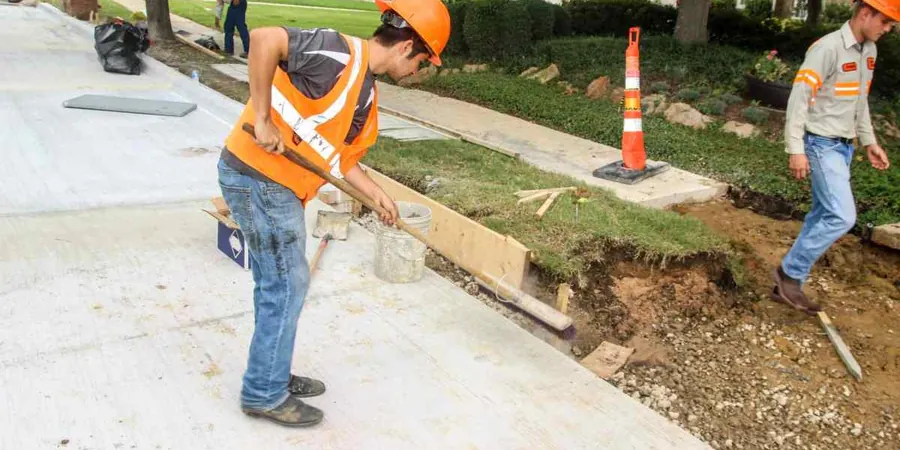
The slip-form paver advances along the alignment, its vibratory pans consolidating the fresh concrete against the side forms in a single continuous pass. Behind it, a texture drag applies the specified macrotexture depth before curing compound is sprayed. In Wexford, where many routes traverse reclaimed estuarine margins along the Slaney, the performance of a rigid pavement depends on what happens beneath the slab. Our team approaches each Wexford project with a focus on subgrade characterization and load transfer efficiency at the joints. Before specifying slab thickness or reinforcement, we correlate data from in-situ permeability testing to assess drainage capacity under the pavement structure, especially in low-lying areas south of the N25 corridor where groundwater sits within 1.2 m of the surface during winter months.
A well-designed joint in Wexford's conditions manages curl, transfer, and ingress in equal measure — miss one and the slab life drops by half.
Local considerations
A recurring condition in Wexford is the presence of soft estuarine silts beneath a desiccated crust. A pavement engineer who only tests the top 300 mm will overestimate the support modulus, producing an underdesigned slab that cracks within the first three thermal cycles. We have observed this in several industrial estate expansions near the harbour area. The solution involves deeper probing — 1.5 m minimum — and correlating the results with seasonal water table records. Pumping at transverse joints becomes a progressive failure mechanism if free water accumulates in the granular subbase; once fines migrate, voids form under the slab corners and mid-panel cracking follows. Designing the subbase as a drainage layer, with positive crossfall and edge outlets, is not optional in low-lying Wexford terrain. Load transfer restoration through retrofit dowel installation is costly and disruptive, so getting the initial joint design right — including elliptical dowel bars where movement exceeds 5 mm — avoids long-term maintenance liability.
Applicable standards
I.S. EN 13877-1:2013 (Concrete pavements — Part 1: Materials), I.S. EN 13877-2:2013 (Concrete pavements — Part 2: Functional requirements), NRA HD 26/06 (Pavement and Foundation Design — rigid pavements), NRA HD 27/06 (Pavement Construction — concrete pavements), I.S. EN 1992-1-1:2004 + NA (Eurocode 2 — concrete structures, Irish National Annex), BS 8500-1:2015 + A2:2019 (Concrete — complementary Irish guidance)
Frequently asked questions
What is the typical cost range for rigid pavement design on a Wexford commercial site?
For a standard commercial development or access road in the Wexford area, the engineering design fee typically ranges from €1,850 to €6,170. The scope covers subgrade investigation, thickness design, joint layout, reinforcing schedules, and construction specification. Complex sites with poor ground, heavy industrial loading, or extensive drainage requirements fall toward the upper end. Each quotation is based on the specific pavement area, traffic category, and site constraints.
How does Wexford's marine climate affect concrete pavement durability?
The combination of airborne chlorides near the coast and frequent rainfall cycles accelerates the risk of corrosion at joint dowels and tie bars if cover is insufficient. We specify minimum 50 mm cover to reinforcement in exposed locations and use epoxy-coated dowels where exposure class XS2 or XS3 applies per I.S. EN 206. The wet-dry cycling also stresses joint sealants — a low-modulus silicone with movement accommodation factor above 25% is preferred over hot-poured materials in this environment.
What ground investigation is needed before designing a rigid pavement in Wexford?
The investigation should extend to at least 1.5 times the depth of the stress influence zone — typically 1.5 to 2.0 m below formation level in Wexford's soft alluvial areas. We require dynamic cone penetration or plate load tests to establish the modulus of subgrade reaction, plus laboratory classification of the subgrade to determine frost susceptibility and sulfate content. Where groundwater is high, standpipe piezometers installed for two seasonal readings give the design water level for drainage calculations.
What is the minimum concrete strength class for rigid pavements under Irish standards?
Per NRA HD 26/06 and I.S. EN 13877-1, the minimum characteristic 28-day flexural strength is typically 4.5 MPa for lightly trafficked pavements, rising to 5.5 MPa for heavy industrial or port applications. This translates to a C28/35 or C32/40 cylinder strength class depending on aggregate type. Air entrainment of 4-6% is specified for all external concrete exposed to freeze-thaw conditions, which can occur in inland Wexford during winter nights.