← Home · Laboratory

Laboratory CBR Testing for Pavement Design in Wexford

Together, we solve the challenges of tomorrow.

LEARN MORE →

With over 145,000 residents spread across a county that receives 1,000 mm of rainfall annually, Wexford's infrastructure demands pavement designs that can handle saturated subgrades without failing. The laboratory CBR test gives us the soaked strength value that directly determines pavement thickness, and for Wexford's glacial tills and alluvial clays, this number often falls below 3% unless the material is properly stabilized. We run the test to BS 1377-4:1990 and IS EN 13286-47:2021 at our accredited soils lab, delivering results that feed straight into your TII NRA HD 26/06 or local authority pavement design. Having tested materials from Enniscorthy to Rosslare, we know which Wexford soils compact well and which ones need lime treatment before the CBR test on site can confirm field performance.

A soaked CBR below 2% can double your pavement thickness compared to a 5% subgrade — the lab test pays for itself in the first 50 meters of road.

Methodology and scope

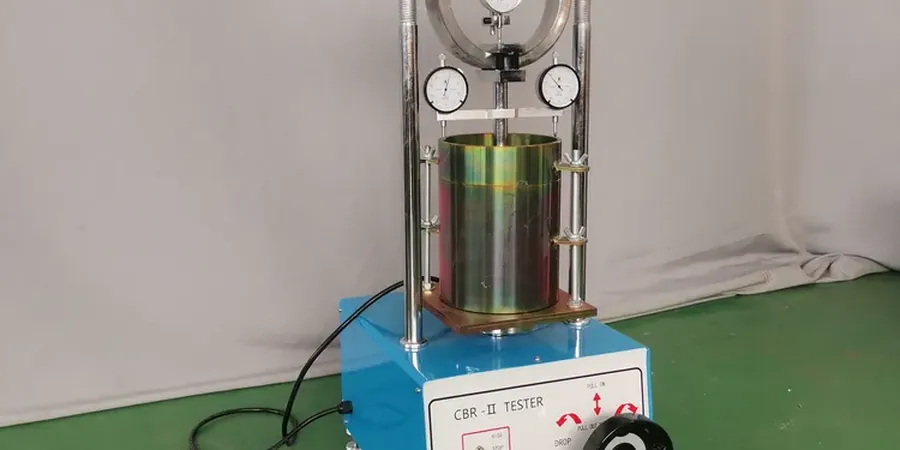
The soaked laboratory CBR procedure we follow replicates the worst-case moisture scenario that Wexford subgrades face during winter months. A remolded specimen is compacted at optimum moisture content, then submerged for 96 hours under a surcharge weight before penetrating it with a 49 mm plunger at 1.27 mm/min. The force readings at 2.5 mm and 5.0 mm penetration are compared against standard crushed stone values, expressed as a percentage. For cohesive soils common around Wexford town and Gorey, we often see CBR values between 1.5% and 4% after soaking, which means pavement thicknesses jump significantly unless a capping layer or stabilisation is introduced. Where granular subbase is sourced from local quarries, the CBR typically exceeds 30%, and we combine this data with Proctor compaction tests to establish the density-moisture relationship that governs site compaction targets.
Laboratory CBR Testing for Pavement Design in Wexford
Technical reference image — Wexford

Local considerations

Wexford's combination of high rainfall and widespread glacial till creates a subgrade condition where the soaked CBR value can differ dramatically from the unsoaked figure. A contractor who designs a pavement based on a dry CBR test is taking a risk that shows up two years later as rutting and cracking. The laboratory CBR test removes that uncertainty by saturating the sample before testing — the same way the subgrade will behave after a wet Irish winter. For agricultural access roads and dairy farm yards, where heavy tankers and slurry spreaders operate on thin pavements, a CBR below 2% means the road will deform within the first season unless a geogrid or stabilised layer is included. We've seen this pattern repeatedly across County Wexford, and the test data lets designers specify exactly the granular layer thickness needed to bridge weak ground without over-engineering the section.

Need a geotechnical assessment?

Reply within 24h.

Email: contact@geotechnical-engineering.co

Technical parameters

ParameterTypical value
Test standardIS EN 13286-47:2021, BS 1377-4:1990
Specimen compactionProctor mould (2.5 kg or 4.5 kg rammer)
Soaking period96 hours under water
Surcharge weightEquivalent to overlying pavement mass
Penetration rate1.27 mm/min
Plunger diameter49.6 mm (standard)
Typical Wexford subgrade range1.5% – 6% (soaked)
Granular subbase range30% – 80%+

Associated technical services

01

Soaked CBR Testing for Pavement Design

Complete laboratory CBR determination under 96-hour soaked conditions per IS EN 13286-47. Includes Proctor reference density, swell measurement, and a design report with recommended pavement layer thicknesses for Wexford subgrade conditions.

02

Combined CBR and Soil Classification Package

Laboratory CBR paired with particle size distribution, Atterberg limits, and moisture content — the full characterisation needed for TII-compliant pavement design submissions to Wexford County Council.

Applicable standards

IS EN 13286-47:2021, BS 1377-4:1990, TII NRA HD 26/06 (Pavement Design), IS EN 13285 (Unbound mixtures)

Frequently asked questions

How much does a laboratory CBR test cost in Wexford?

A standard soaked laboratory CBR test in Wexford typically costs between €110 and €160 per specimen, depending on the number of compaction points required and whether the full Proctor curve is needed alongside the CBR. Most pavement design projects require three specimens at a minimum, so you're looking at €330 to €480 for a complete data set. The test cost is negligible compared to the pavement material savings it enables — a design based on real CBR data rather than a conservative assumption can reduce granular fill thickness by 100 to 200 mm, which on a 500-metre access road saves thousands of euros in imported stone.

How long does the laboratory CBR test take from sample collection to results?

The soaked CBR procedure requires a minimum of five working days: one day for sample preparation and compaction, four days (96 hours) for the soaking phase under water, and the final day for penetration testing and report writing. If we need to run the Proctor compaction test first to establish the optimum moisture content, add two more days. We can compress the timeline for urgent projects in Wexford by running the Proctor and CBR specimens in parallel, but the 96-hour soaking period is non-negotiable — it's what gives you the saturated strength that actually represents winter ground conditions.

What's the difference between a laboratory CBR and a field CBR test?

A laboratory CBR test is performed on a remoulded sample compacted to a controlled density and moisture content, then soaked for 96 hours before penetration. It tells you the strength of the material under worst-case saturated conditions. A field CBR test, by contrast, is performed directly on the compacted layer in situ using a reaction vehicle and gives you the as-built strength at the current moisture state. In Wexford, we typically recommend the laboratory CBR during the design phase to set the specification, and the field CBR during construction to verify the contractor has achieved the required compaction. Both are needed for a defensible pavement design.
Location and service area

We serve projects across Wexford and its metropolitan area.

View larger map