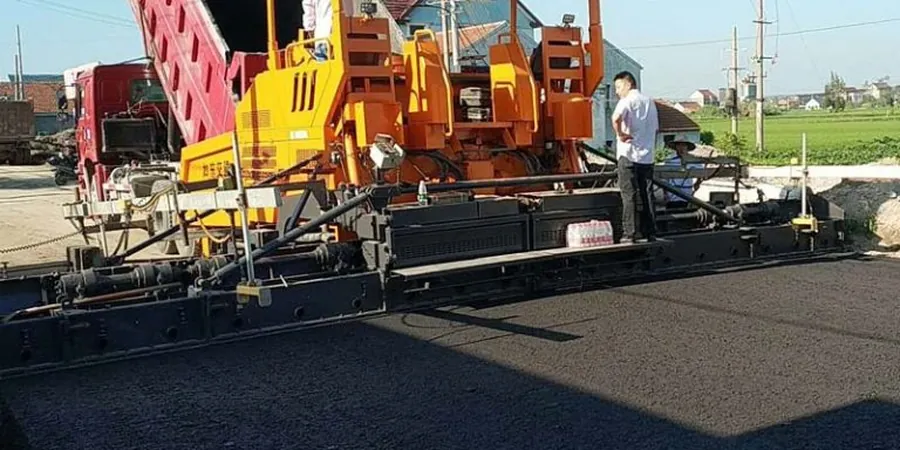
The south-east coast of Ireland presents a unique challenge for road engineers, and nowhere is this more apparent than in Wexford. The county’s underlying geology shifts from the granite of the Blackstairs Mountains to the soft, compressible alluvial clays that line the Slaney Estuary and Wexford Harbour, where groundwater often sits less than a metre below the surface. Combined with an average annual rainfall approaching 1,200 mm, these conditions mean a standard pavement cross-section simply will not hold up over time. In our experience, a durable flexible pavement design in Wexford must start with a thorough understanding of the subgrade’s behaviour under saturated conditions, which is why we integrate in-situ permeability testing early in every project to quantify how water moves through the foundation soils and to size the drainage layer accordingly.
A pavement’s lifespan in Wexford is decided not by the asphalt thickness but by how well the design anticipates six months of saturated subgrade.
Local considerations
The TII Publication DN-PAV-03023 provides the analytical framework for flexible pavement design in Ireland, but its practical application in Wexford requires careful interpretation of the saturation conditions. The county’s shallow water tables, particularly around the harbour and polder lands south of Wexford town, mean that a pavement foundation classified as Class S2 during a dry summer investigation can degrade to an S4 condition by February. If this seasonal weakening is not captured in the design traffic calculation, the pavement accumulates fatigue damage at a rate far exceeding the structural model predictions. The consequence is rarely catastrophic failure but rather a progressive loss of serviceability: longitudinal cracking along wheel paths, edge break-up on narrow rural roads, and expensive patching cycles that disrupt local traffic. Including a properly graded capping layer and designing the drainage system to intercept groundwater before it reaches the formation level are not optional refinements in this environment; they are the difference between a 20-year pavement and one that needs structural rehabilitation in under a decade.
Frequently asked questions
What is the typical cost of a flexible pavement design for a site in Wexford?
The fee for a flexible pavement design package in Wexford, including site investigation planning, laboratory CBR testing, and the structural design report, generally falls between €1,370 and €4,210 depending on the project length and traffic loading complexity. A short residential cul-de-sac with low design traffic sits at the lower end, while a commercial distribution yard or a section of regional road requiring FWD survey and rehabilitation design will be at the upper end of that range.
How does Wexford’s high water table affect pavement design?
The shallow groundwater we encounter across much of Wexford, particularly near the Slaney and in the harbour area, keeps the subgrade in a near-saturated state for months at a time. This reduces the effective CBR significantly compared to summer values, so we apply a seasonal adjustment and design the drainage system to maintain the water table at least 500 mm below formation level. Without this, the unbound layers pump fines and the pavement loses structural integrity within a few seasons.
What traffic data do you need to start the design?
We typically work from the client’s projected commercial vehicle counts, axle load surveys where available, and the intended design life—usually 20 years for public roads. For industrial sites in Wexford, such as around Rosslare Europort, we also account for static loading from parked trailers and turning movements that concentrate stress in ways a linear road model does not capture, which sometimes requires a separate finite element check of the critical loading bays.
Can you design a flexible pavement using site-won materials to reduce imported aggregate costs?
The reference range for this service in Wexford is €1.370 - €4.210. The final price depends on the project scope and volume.