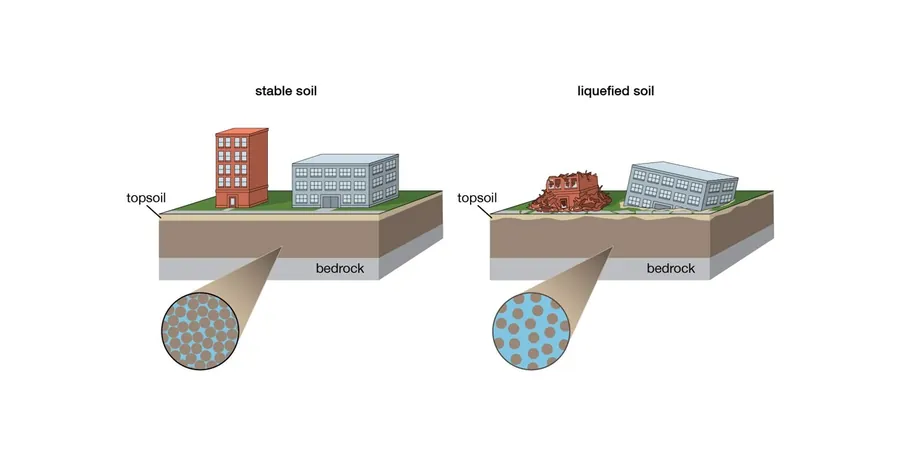
Drive from the granite headlands south of Wexford town towards the softer estuarine deposits near the Slaney River mouth, and you feel the difference under your feet before you see it. The solid ground of the Leinster batholith gives way to loose, saturated silts and sands where the water table sits less than two meters down. That change isn't just academic—it defines how the ground will behave when cyclic loading hits. In Wexford, we’ve run boreholes where the SPT N-value drops below 6 in the upper 4 meters, and that’s precisely the profile where pore pressure can spike and effective stress vanishes during a moderate seismic event. The challenge here isn’t big quakes; it’s the combination of shallow groundwater, young alluvial fills, and a built environment that rarely accounted for dynamic loading when foundations were poured. We pair field investigation with the CPT test to get a continuous tip resistance profile, and for sites near the quay where vibration is a concern we layer in MASW to measure shear-wave velocity without disturbing the already sensitive fabric.
In Wexford’s estuarine silts, a corrected SPT N-value of 8 at 3 meters depth can trigger a factor of safety below 1.1 under a PGA of just 0.08g—a reminder that low-seismicity doesn’t mean no risk.
Local considerations
The mild, damp climate of the southeast gives Wexford some of the highest annual rainfall totals in Ireland—over 1,100 mm near Johnstown Castle—and that keeps the water table persistently high in the alluvial corridors. For liquefaction risk, this means the soil profile rarely drains fully, so even a winter construction dewatering effort doesn’t buy you a permanently lower groundwater level. We’ve seen sites along the quays where the phreatic surface sits at 1.2 meters in August as well as February, leaving a thin crust of unsaturated silty sand that offers negligible confining resistance. In a design-basis event, that crust can crack and settle differentially, causing angular distortion in shallow footings that exceeds the 1/500 limit for masonry structures. And because Wexford’s historic core has so many party-wall terraces, a localized bearing failure in one unit propagates laterally. Beyond structural damage, lateral spreading toward the Slaney channel is a real concern for waterfront properties, where even 50 mm of permanent ground displacement can rupture buried utilities and render a building uninhabitable for months.
Applicable standards
Eurocode 8 Part 5 (EN 1998-5:2004) – Foundations, retaining structures, and geotechnical aspects, NCEER/NSF Workshop (Youd & Idriss, 2001) – Simplified liquefaction triggering procedure, ASTM D1586-18 – Standard Test Method for SPT and Split-Barrel Sampling, ASTM D5778-20 – Standard Test Method for CPT with pore pressure measurement, ISO 22476-1:2012 – Field testing for geotechnical investigation and testing
Frequently asked questions
What does a soil liquefaction analysis cost for a typical Wexford residential site?
For a single-dwelling site with two boreholes and full lab testing, the analysis typically falls between €2,010 and €3,880. The range depends on depth to refusal, number of SPT intervals, and whether we need to add CPT soundings or geophysical Vs profiling. A commercial development with more than four investigation points will sit at the upper end or beyond, especially if lateral spreading requires separate assessment.
Is Wexford really at risk of earthquakes that would cause liquefaction?
Ireland sits on a stable intraplate setting, so peak ground accelerations are modest—typically 0.06–0.10g for a 475-year return period. But the ground in Wexford’s river corridor is so soft and saturated that even these low accelerations can trigger excess pore pressure in loose silty sand lenses. Eurocode 8 requires a check when design acceleration exceeds 0.05g and the water table is shallow, which covers most of the town centre.
How long does a liquefaction study take from start to final report?
Fieldwork—drilling or CPT—usually takes two to four days on site, depending on access and depth. The lab programme adds seven to ten working days for grain-size, Atterberg, and fines content on every relevant sample. We deliver the interpretive report with factor-of-safety profiles and settlement estimates within three weeks of the final field day, though we can expedite to ten working days for urgent project schedules.
Can you mitigate liquefaction risk without deep foundations?
Sometimes, yes. If the liquefiable layer is thin and within a few meters of the surface, ground improvement like vibrocompaction or stone columns can densify the deposit and raise the CRR above the demand. For deeper or thicker layers, or where adjacent structures limit vibration, we typically recommend a piled foundation that transfers load below the critical zone, combined with a structurally connected grade beam to handle differential settlement.