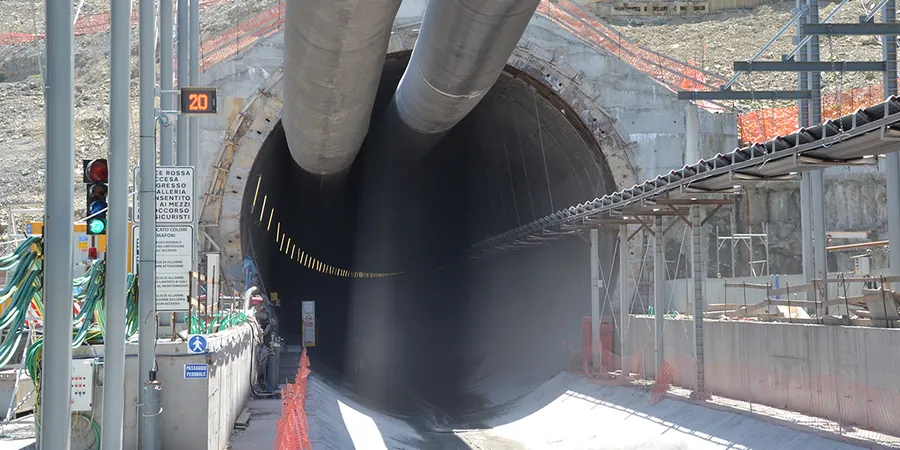
The most expensive mistake we see on Wexford sites isn't a collapsed wall—it's an excavation that stays open but causes half a million in damage to the Georgian terrace next door. Wexford's layered ground profile, a mix of stiff boulder clay over softer estuarine silts near the Slaney, catches out designers who rely on textbook parameters. A deep excavation here demands more than a standard retaining wall check; it requires a clear understanding of how groundwater moves through the Rathmacknee formation and how sensitive adjacent structures react to even minor movements. That's where a site-specific geotechnical investigation becomes essential before any shoring design. We combine local drilling data with advanced numerical modelling to design excavation support systems that keep your programme on track and your neighbours' foundations intact.
In Wexford's tidal groundwater regime, a deep excavation design that ignores cyclic pore pressure fluctuation is a design that will fail before the first lift is poured.
Local considerations
Eurocode 7 (EN 1997-1:2004) requires that the design of any deep excavation be verified for ultimate limit state and serviceability, but in Wexford, serviceability governs 80% of urban jobs. The soft, normally consolidated silts along the quays and near the Crescent can creep under sustained load, causing settlement damage to masonry structures 30 metres behind the excavation face. Ignoring this means you could meet the factor of safety on paper but still face legal claims for cracking. Our team uses hardening soil models with small-strain stiffness, calibrated to local oedometer and triaxial data, to predict movements within millimetres. We also account for tidal fluctuation in groundwater levels near the harbour, which introduces cyclic loading on temporary supports that a steady-state analysis completely misses.
Frequently asked questions
What ground investigation data do you need before designing a deep excavation in Wexford?
We need a site-specific ground investigation with boreholes extending at least 1.5 times the excavation depth below formation level. For a typical Wexford town centre site, that means 8–12 metre boreholes with SPTs, undisturbed sampling in the soft silts, and standpipe piezometers to capture the tidal groundwater response. Lab testing should include consolidated-undrained triaxial tests with pore pressure measurement and oedometer tests on the compressible layers.
How much does a geotechnical design for a deep excavation cost in Wexford?
For a complete design package—ground model interpretation, retaining wall design with staged excavation analysis, dewatering plan, and monitoring specification—the fee typically ranges from €1,900 to €6,560 depending on excavation depth, proximity to adjacent structures, and complexity of the groundwater regime. A straightforward single-level basement on a greenfield site sits at the lower end; a multi-level excavation between two protected structures on Main Street would be at the upper end.
Can you design an excavation support system that allows us to work right up against the neighbouring building?
Yes, and we do it regularly in Wexford's tight urban plots. The key is selecting a rigid system—secant piles or a contiguous piled wall—and modelling the precise construction sequence. We assess the existing building's tolerance to movement, often using a category 1 or 2 damage classification per Burland's methodology, and design the wall stiffness and propping sequence to keep angular distortion below 1/500. We'll also specify compensation grouting if the risk assessment requires it.
How do you handle the high groundwater table in Wexford during deep excavation design?
We design either a cut-off wall system that keys into the low-permeability glacial till to minimise inflow, or a combined cut-off and dewatering system where full penetration isn't achievable. The design includes a transient seepage analysis to quantify steady-state inflow and drawdown effects. Crucially, we check for hydraulic uplift in the base of the excavation—a real risk in the silty layers near the Slaney—and design pressure relief wells or an increased embedment depth if necessary.