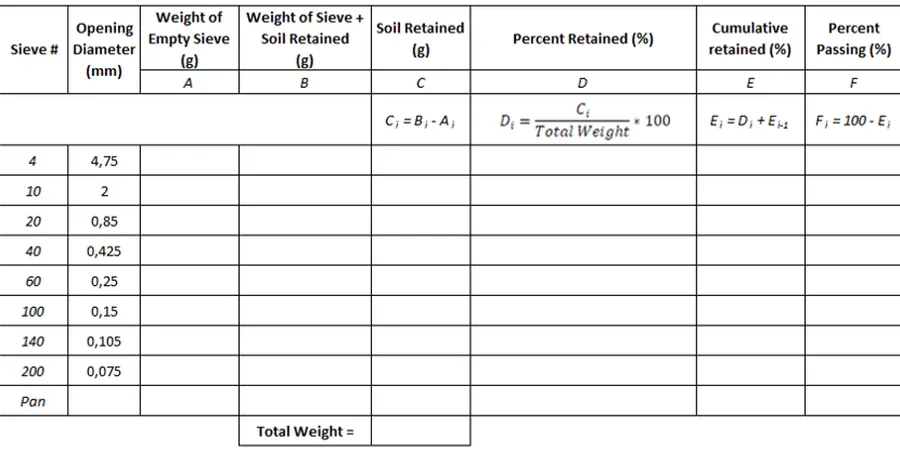
Wexford's underlying geology, dominated by Ordovician slates and shales mantled with glacial tills deposited during the last ice age, creates a complex matrix of boulder clays interbedded with pockets of soft silty alluvium along the River Slaney and its tributaries. The gradation of these materials often dictates the feasibility of shallow foundations versus deep pile systems, making a precise grain size analysis non-negotiable for ground investigation campaigns in the town and its expanding suburbs. Our ISO 17025-accredited laboratory processes samples from boreholes and test pits across the county, applying the full hydrometer and sieve protocol to quantify the fines content that controls drainage and frost susceptibility. For projects in the reclaimed estuarine zones near Wexford Harbour, the distinction between a silty sand and a sandy silt — only resolvable through a grain-size analysis — carries significant implications for liquefaction screening and settlement prediction in the loosely consolidated deposits.
In Wexford's glacial tills, the hydrometer curve reveals the clay fraction that sieve analysis alone misses — and that fraction dictates the consolidation timeline for any foundation.
Local considerations
Soil conditions shift dramatically between the well-drained, sandy gravels of the Clonard area and the compressible, organic-rich clays mapped along the riverbanks near Wexford Bridge. On the northern side, a clean, poorly graded sand with less than 5% passing the 75 µm sieve might support a bearing capacity of 200 kPa without significant settlement, but the same structural load applied to the silty clay of the south quays, where the hydrometer test reveals over 70% clay-sized particles, could induce differential settlements exceeding 25 mm over a single building footprint. The risk intensifies in Wexford's rural townlands where glacial till contains erratic cobbles and boulders — skip the full particle size distribution and the design may mischaracterize a matrix-supported diamict as a granular soil, underestimating pore pressure buildup during heavy winter rainfall. A complete grain size analysis, specifically the hydrometer sedimentation phase, identifies the clay fraction that governs both long-term consolidation and the potential for shrink-swell behavior in the region's weathered slate-derived subsoils.
Frequently asked questions
What is the typical turnaround time for a grain size analysis in your Wexford lab?
A standard combined sieve and hydrometer test is reported within 72 hours of sample receipt. For urgent ground investigation campaigns, we offer a 24-hour expedited service where the coarse fraction sieve is prioritized immediately and the hydrometer readings are processed overnight. The sedimentation phase alone requires a minimum of 24 hours of undisturbed settling, which sets the physical limit on turnaround. We notify the project engineer by email as soon as the final gradation curve and USCS classification are validated.
How much sample is required for a full grain size analysis with hydrometer?
For a complete sieve plus hydrometer analysis, we typically need at least 500 grams of dry soil passing the No. 4 (4.75 mm) sieve, or approximately 2 kg of bulk sample if significant coarse gravel is present. The hydrometer test specifically requires 115 grams of the air-dried minus No. 10 fraction. Samples should be sealed in airtight bags immediately after extrusion to preserve natural moisture content, and we can arrange collection from site offices anywhere in County Wexford.
What is the cost of a grain size analysis in Wexford?
The price for a routine combined sieve and hydrometer analysis in our Wexford facility ranges from €90 to €160 per sample, depending on whether the material is predominantly granular (faster sieving, less sedimentation) or fine-grained (extended hydrometer readings, additional dispersion checks). This covers the full report with the gradation curve, D-values, and the USCS classification. Bulk discounts apply for projects submitting more than 20 samples from a single investigation contract.
Does your lab follow the British Standard or ASTM for grain size tests?
We run the mechanical sieve analysis to both ASTM D6913 and BS 1377-2:1990, and the hydrometer sedimentation per ASTM D422 with the 152H hydrometer, which is the specification most commonly requested by consulting engineers on Wexford's residential and commercial developments. The BS 1377-2 pipette method can be performed upon request. Our ISO 17025 scope, accredited by INAB, covers both standards, and we cross-reference the resulting particle size distribution with the Eurocode 7 classification system for projects that follow the Irish National Annex.