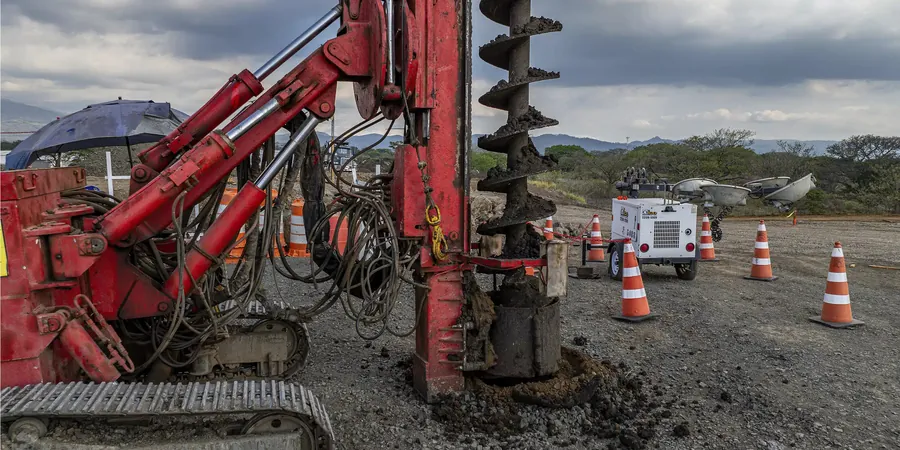
Wexford's development along the muddy banks of the River Slaney created a legacy of construction on soft, compressible ground. The town's medieval core sits on a narrow ridge of firmer glacial till, but the expansion into Ferrybank and the quay areas pushed building onto deep alluvial silts and clays that can reach depths of 15 metres or more. These estuarine deposits, remnants of Wexford Harbour's tidal history, offer bearing capacities often below 60 kPa. Stone column design emerged decades ago as the practical local answer, transforming weak compressible layers into composite ground strong enough for industrial warehouses, apartment blocks, and the retail parks that now ring the M11 approach. A well-executed installation, designed to IS EN 1997-1:2005 and informed by site-specific CPT testing profiles, can reduce total settlement by half while accelerating primary consolidation from years to months. For near-shore Wexford sites where groundwater tables sit barely a metre below ground level, the drainage function of the columns becomes just as critical as the reinforcement, preventing pore pressure build-up during seismic events under Irish Annex NA to EN 1998-1.
A stone column grid designed for Wexford's estuarine clays can cut settlement time from three years to under three months while doubling the composite ground bearing capacity.
Local considerations
The contrast between Wexford's town centre and the outskirts is stark from a geotechnical perspective. The central spine running along Main Street and into School Street sits on reasonably competent glacial till, where stone column design is rarely needed. But move half a kilometre east toward the harbour or south toward the low-lying lands around the Slaney estuary, and the ground profile shifts dramatically to thick sequences of normally consolidated estuarine mud. The risk of skipping proper ground investigation in these transition zones is severe—structures founded on shallow footings in the mistaken belief that conditions mirror the town centre have experienced total settlements exceeding 120 mm within the first year. A critical design risk peculiar to Wexford is the presence of buried paleochannels, old river courses now filled with organic silt and peat that can be completely missed by widely spaced boreholes. When stone columns penetrate these hidden pockets, the stone take per linear metre can spike unpredictably, requiring a flexible contract mechanism. Our ground investigation with test pits prior to column layout often reveals these features early, allowing the design grid to be locally tightened before installation begins.
Frequently asked questions
What is the typical cost for stone column design and verification for a Wexford commercial building?
For a medium-scale commercial or industrial structure in Wexford, the combined design, specification, site supervision, and verification testing typically ranges from €1.280 to €5.350, depending on the number of columns, the depth of treatment, and the complexity of the ground profile. Projects requiring multiple load tests or detailed FE modelling fall at the upper end.
How long does consolidation take after stone columns are installed in Wexford's estuarine clays?
Because the stone columns act as vertical drains, consolidation in Wexford's estuarine clays accelerates dramatically. Typical projects see 90% of primary settlement completed within 6 to 14 weeks, compared to 2 to 5 years without treatment. A drainage blanket connecting the column heads is essential to achieve these timelines.
What stone material is suitable for columns in Wexford?
The stone fill must comply with IS EN 14701 and typically consists of clean, hard, crushed limestone or granite with a nominal size between 25 mm and 75 mm. Fines content passing the 63-micron sieve should be below 5%. Local quarries near Wexford can generally supply suitable material, but the gradation must be verified by sieve analysis before the installation begins.
Can stone columns be installed through Wexford's buried peat layers?
Yes, but with caution. The buried peat pockets common in Wexford's paleochannels present a challenge because the very low lateral confinement can lead to excessive stone take and column bulging. The design must account for this by potentially tightening the grid locally or increasing the column diameter through those zones, and the installation record must be closely monitored for sudden changes in stone consumption.