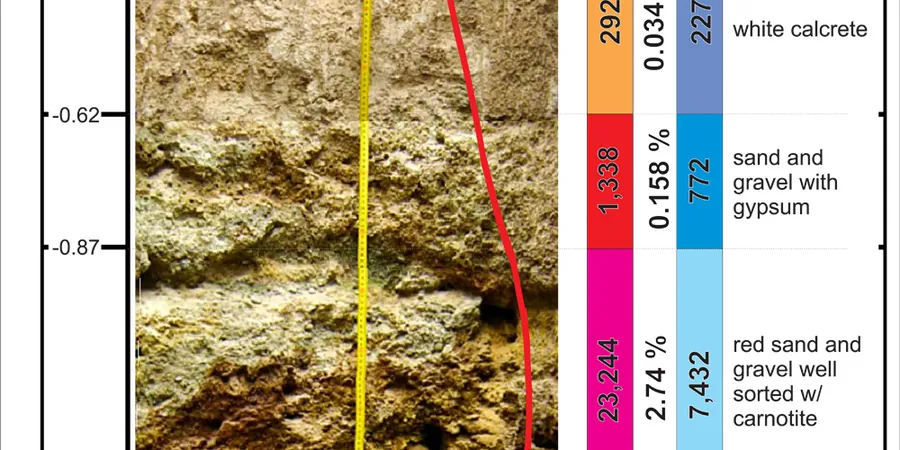
BS 5930:2015 and Eurocode 7 (EN 1997-2:2007) frame every exploratory test pit we open in County Wexford. The geology here is deceptively varied. Glacial tills blanket much of the countryside north of Wexford town, while alluvial silts and soft clays dominate the Slaney River floodplain. A desk study alone cannot distinguish a dense lodgement till from a weathered shale at two metres depth. That distinction changes the foundation design. A machine-excavated trial pit puts the geotechnical engineer face to face with the strata. Soil fabric, moisture condition, and seepage are observed directly. For sites near Wexford Harbour, where the underlying mudstone is often overlain by estuarine deposits, the test pits we log provide the first reliable record of the transition zone. When granular lenses appear in the profile, we often recommend pairing the visual log with a CPT test to resolve the undrained shear strength profile without delay.
A test pit is the only investigation method that shows you the soil fabric intact, with its natural structure, joints, and moisture regime visible in section.
Local considerations
The ground south of Wexford town, around Rosslare, behaves nothing like the drumlin tills north of Enniscorthy. The southern coastal strip sits on a thin cover of sand over marine clay. A trial pit in that setting reveals the water table within the first metre of digging. If the pit is not sheeted or battered back adequately, the saturated sand collapses before the log is complete. That risk is physical, immediate, and entirely avoidable with a trench box. Then there is the regulatory risk. A pit opened without locating underground services first can strike a live cable or a gas main. We run a full CAT and Genny sweep before the excavator bucket touches the ground. The third risk is interpretative. A pit that exposes a stiff brown clay at 2.5 m might be misinterpreted as a lodgement till when it is actually a desiccated crust over soft laminated clay. Only an experienced engineer can read the difference in the pit face. Missing that distinction leads to an overestimation of bearing capacity and a foundation that settles differentially within the first wet winter.
Frequently asked questions
What is the typical cost of an exploratory test pit investigation in Wexford?
For a standard residential site investigation involving two to three test pits logged by an engineer, the cost in County Wexford generally falls between €440 and €780. The final figure depends on access conditions, pit depth, whether a trench box is required, and the number of samples sent for laboratory testing. We provide a fixed-price quote after reviewing the site location and the proposed foundation layout.
How long does a test pit stay open during investigation in Wexford?
A single pit is usually logged, sampled, and photographed within one to two hours. The engineer remains on site the entire time. Backfilling commences immediately after the log is signed off. If percolation tests are required, the pit may stay open for an additional two to four hours to complete the water-level readings. We never leave a pit unattended overnight.
Do you notify services before digging a test pit in Wexford town?
Yes. Before any machine excavation, we carry out a Cable Avoidance Tool scan and signal generator sweep across the entire pit area. We also consult the utility mapping records available through the local authority. In Wexford town centre, where service density is high, we often hand-dig the first 1.2 metres as an additional safety measure.