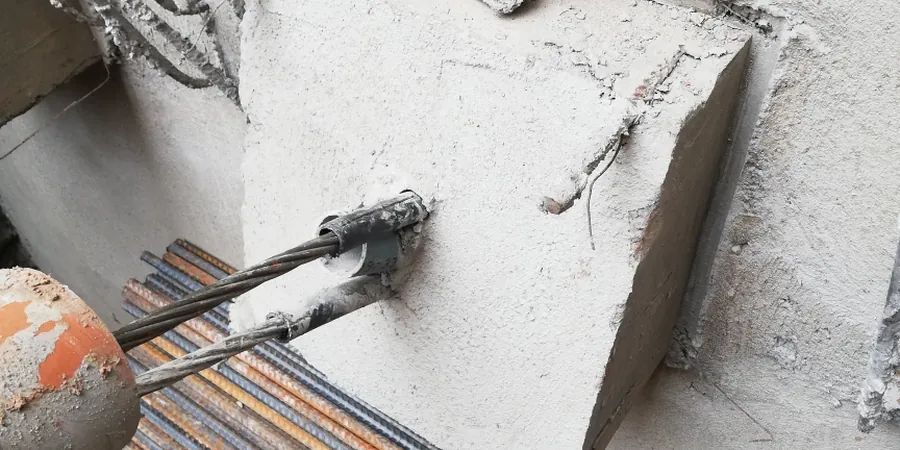
Eurocode 7 (EN 1997-1:2004) requires a clear distinction between active and passive anchor systems, and in Wexford that distinction matters more than most engineers first assume. The town sits on a mix of Irish Sea till overlying weathered Ordovician slates, with soft alluvial pockets along the Slaney estuary where anchor capacity can drop sharply if the design does not account for low overburden stresses near the surface. A passive anchor relying on grout-to-ground bond in those estuarine silts behaves very differently to a stressed active tendon locked into the underlying rockhead. The local authority will ask for a design basis that ties every assumption back to site-specific ground investigation, which is why we combine anchor design with data from CPT testing to build a reliable ground model before the first tendon is ever ordered.
An active anchor transfers load deep into competent ground, but in Wexford's tidal clays the real challenge is proving that the fixed length stays fixed over the structure's design life.
Methodology and scope
The typical ground profile west of Wexford town centre shows dense lodgement till at depths of 3 to 6 metres, with SPT N-values above 30, providing excellent passive anchorage. Move closer to the quayfront, however, and the till thins out, replaced by soft estuarine clays with undrained shear strengths often below 30 kPa. These clays need active anchors with a carefully calculated fixed length, because creep over time can relax the lock-off load and compromise the retaining structure. A characteristic of anchor design in Wexford is that groundwater levels track the tidal cycle of the Slaney River, fluctuating by up to 1.4 metres twice a day. This tidal influence means corrosion protection cannot be an afterthought; we specify double-corrosion-protected (DCP) tendons as standard, with factory-applied sheathing and heat-shrink joints tested at 1.5 times the design load. For permanent works, the grout mix includes microsilica to reduce bleed and improve bond in saturated ground. The design process also accounts for the proximity of protected quay structures, where vibration from drilling must be kept low, so rotary duplex drilling with water flush is often preferred over down-the-hole hammering.
Local considerations
A pattern we have observed repeatedly on Wexford projects is that the contractor assumes the till is uniform, only to hit a pocket of water-bearing sand at the till-rock interface. If the fixed anchor length straddles that interface, the grout can wash out before it sets, leaving a tendon with zero bond in the critical zone. The result is not a sudden failure but a slow, progressive loss of pre-stress that shows up months later as wall deflection exceeding the serviceability limit. Another local risk is anchor interaction with existing quay wall foundations along the Crescent Quay area; older masonry walls were often built on timber piles that are not documented, and drilling through them creates a hydraulic connection between the river and the retained fill, accelerating internal erosion. We mitigate these risks by requiring rotary coring through the bond zone to confirm geology before grouting, and by instrumenting at least ten percent of production anchors with load cells that feed into a remote monitoring dashboard shared with the resident engineer.
Frequently asked questions
What is the difference between active and passive anchors?
Active anchors are pre-stressed after installation, applying a controlled load to the structure immediately. Passive anchors only develop resistance when the ground starts to move, so they allow some deformation before they engage. In Wexford's soft estuarine clays, active anchors are normally required because passive systems would need too much displacement to mobilise capacity, potentially damaging adjacent quay structures.
How long does anchor design take for a Wexford site?
A typical design package takes three to four weeks from receipt of the ground investigation report. This includes the design basis, bond length calculations, corrosion protection specification, and the testing schedule. If trial anchors are required to verify bond assumptions in marginal ground, add a further two weeks for installation and testing before the production design is finalised.
What does active/passive anchor design cost?
Design fees normally range from €970 for a straightforward soil nail verification to €3,420 for a full active anchor design package with proof testing specification and load cell monitoring plan. The spread reflects the complexity of the ground and the number of anchor rows. Trial anchor testing is additional and quoted separately.
Can anchors be installed close to existing quay walls in Wexford?
Yes, but with precautions. The main risk is drilling through undocumented timber piles or creating a hydraulic path between the river and the retained fill. We specify rotary duplex drilling with a temporary casing through the fill, and the bond zone is located at least 2 metres behind the theoretical failure plane of the existing wall. A watching brief during drilling is mandatory, and we recommend instrumenting the adjacent wall with tiltmeters for the first month after stressing.