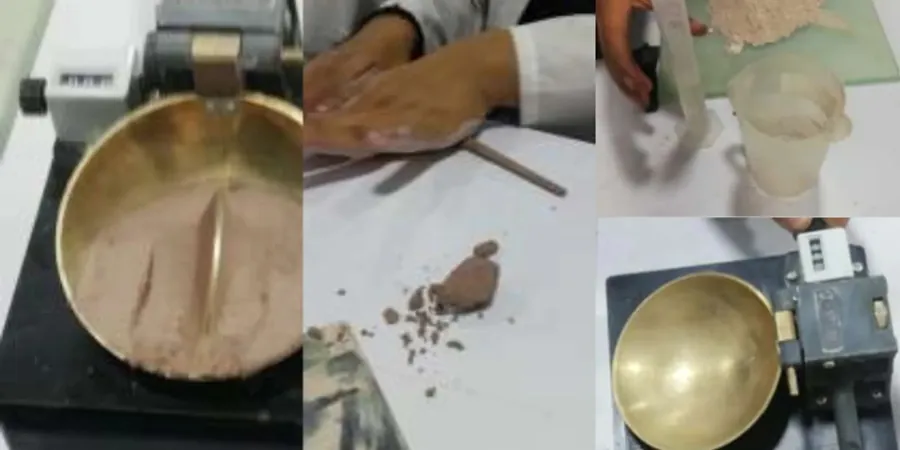
Wexford’s built environment has expanded from its medieval Norse core onto the soft alluvial clays and glacial tills that line the Slaney estuary. These fine-grained soils, deposited during the last glaciation and reworked by river meanders, can hold substantial moisture and change volume dramatically with seasonal wetting and drying. The town’s average annual rainfall of about 1,100 mm means site drainage is rarely a secondary concern. A standard borehole log will tell you the stratum, but it will not tell you how the clay will behave under load or during a wet winter. That is where Atterberg limits testing becomes the critical link between field description and engineering design. We run the tests in our IS EN ISO 17892-12 compliant laboratory, giving Wexford project teams the liquid limit, plastic limit, and plasticity index they need to classify the soil correctly and avoid surprises during excavation. When we encounter highly plastic clays near the harbour, we often recommend pairing the results with a triaxial shear test to confirm undrained strength for foundation bearing capacity calculations.
A plasticity index above 20% in Wexford’s alluvial clays signals high shrink-swell potential—design your footings for it or deal with cracked masonry later.
Local considerations
We regularly see Wexford sites where the top metre of weathered till looks firm and gravelly, but the true clay beneath it has a liquid limit exceeding 60%. If the contractor stops investigating at the first refusal and classifies the whole profile as granular fill, the foundation design will be dangerously unconservative. The real cost shows up two years later when differential heave cracks the blockwork of a domestic extension or a light industrial slab. For volume-sensitive clays with a PI above 25%, the seasonally active zone in southeast Ireland extends to about 1.2 m depth, which means standard strip footings at 900 mm can still be within the influence of moisture fluctuation. We always flag this in the factual report, because replacing a floor slab in Wexford costs far more than a set of Atterberg limits tests run during the site investigation phase.
Frequently asked questions
What do the Atterberg limits actually tell me about my Wexford site?
The liquid limit and plastic limit define the moisture content range over which the clay behaves as a plastic solid. A high plasticity index—say 25% to 40%—means the soil will shrink when it dries and swell when it wets, which is a real concern for light structures on the tills and alluvium around Wexford. The results also place the soil on the Casagrande classification chart (CL, CH, etc.), which determines the appropriate bearing capacity factors and earth pressure coefficients for design.
How much does Atterberg limits testing cost in Ireland?
For a standard set of liquid limit and plastic limit determinations on a single sample, budget between €60 and €100 depending on whether we are also running a particle size distribution or moisture content on the same material. The price reflects the technician time for the Casagrande cup procedure and the thread-rolling, plus the reporting and classification per IS EN 17892-12.
Can you run Atterberg limits on samples from our own excavation or only from your boreholes?
We test disturbed samples regardless of who collected them, as long as the material is bagged and labelled properly and has not dried out completely. We can also mobilise a crew to Wexford to log trial pits or advance boreholes and take the samples ourselves, which gives better control over sample condition and depth recording.
How many Atterberg tests do I need for a typical house extension in Wexford?
For a single-storey extension on a site with uniform geology, two samples from the proposed footing depth—taken at opposite ends—are usually sufficient to confirm the classification and check for variability. If the trial pit shows a change from brown till to grey silty clay at depth, we would test both horizons, so you might end up with three or four determinations to characterise the profile properly.