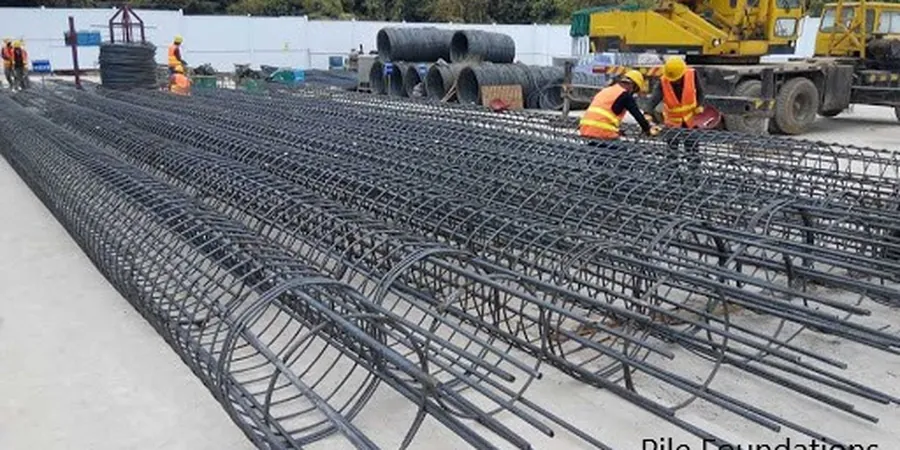
Specifying pile lengths from a desk study alone is the fastest way to blow a foundation budget in Wexford. The town sits on a complex patchwork of glacial till, weathered shale, and pockets of soft alluvial clay along the Slaney floodplain. We see projects every year where piles were designed without a single borehole east of the N11. The result is either refusal at 3 metres where 12 was assumed, or socketed lengths that never hit competent rock. Our pile foundation design work always starts with the same question: what did the ground actually say? From the quayside developments to the new residential schemes off the Rosslare Road, we combine CPT testing data with laboratory triaxial strength parameters before a single pile diameter is chosen. This isn't about applying textbook factors – it is about reading the till correctly.
A pile is only as good as the ground parameters fed into the design. In Wexford's glacial till, that means site-specific triaxial and SPT data, not regional correlations.
Applicable standards
IS EN 1997-1:2004 + Irish National Annex (Eurocode 7 – Geotechnical design), IS EN 1997-2:2007 (Ground investigation and testing), IS EN 1992-1-1:2004 + Irish Annex (Concrete structures – pile reinforcement), IS EN 1993-5:2007 (Steel piling), ICE Specification for Piling and Embedded Retaining Walls (3rd ed.), Institution of Structural Engineers – Manual for the design of concrete building structures to Eurocode 2
Frequently asked questions
How much does pile foundation design cost for a project in Wexford?
For a typical Wexford project involving ground investigation interpretation, axial and lateral pile capacity calculations, and preparation of a design report with pile schedule drawings, the fee ranges from €1,540 to €6,340 depending on the number of pile types, group configurations, and whether dynamic load test analysis is included. A straightforward single-pile-type design with 2–3 boreholes to interpret sits at the lower end of that range.
Which pile type works best in Wexford's glacial till?
Continuous Flight Auger (CFA) piles are the most common choice for Wexford's till because they install quickly through the stiff upper layers without casing and can socket into weathered shale. Driven precast piles also work well on sites with good access, particularly where the till is dense and the shale is shallow enough to reach with standard section lengths.
Do you need to socket piles into rock in Wexford?
Not always. Where the glacial till is dense and homogeneous with SPT N-values above 30, a toe bearing in the till can be sufficient for moderate loads up to about 800 kN. Socketing into the underlying shale becomes necessary when the till is thin, the loads exceed 1,000 kN per pile, or the site is within the Slaney floodplain where soft alluvium overlies the till.
What ground investigation information do you need before designing piles?
We require borehole logs with SPT N-values at 1.5-metre intervals, laboratory classification and strength test results (Atterberg limits, undrained triaxial, point load on rock), and groundwater monitoring data over at least one seasonal cycle. CPT profiles are highly recommended for the soft alluvial zones to get continuous stratigraphy. Without this data, pile lengths and capacities are speculative.
How do you account for the high water table in Wexford town?
The shallow water table affects pile design in two main ways: it reduces effective stress and therefore shaft friction in granular layers, and it complicates pile installation by requiring temporary casing or drilling fluid support through the saturated soft clays. Our design calculations use buoyant unit weights below the water table, and we specify concrete mix designs and placement methods that prevent segregation under high groundwater conditions.