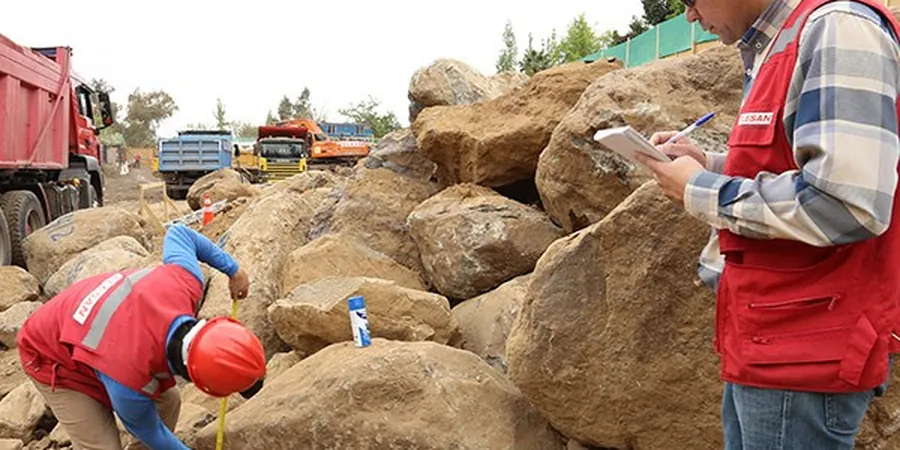
Wexford sits on glacial till with pockets of soft alluvial clay near the Slaney. Rainfall exceeds 1,000 mm annually. That combination turns a straightforward foundation dig into a waterlogged trench fast. A soil mechanics study here must answer one question: will the ground hold under load and saturation. We run shear and consolidation tests on undisturbed samples taken from your site. The data feeds directly into bearing capacity and settlement calculations. No generic assumptions. For deep glacial deposits we often pair lab work with field data from spt-drilling to correlate N-values with strength parameters. It keeps the foundation design grounded in local reality.
Wexford's glacial till can look competent at surface but soften rapidly when saturated. Lab testing quantifies that drop.
Applicable standards
BS 1377-2:1990 (classification, compaction, permeability), BS 1377-7:1990 (shear strength by triaxial), BS 1377-5:1990 (compressibility by oedometer), ISO 17892 series (geotechnical laboratory testing), BS 5930:2015 + A2 (site investigation code of practice)
Frequently asked questions
What does a soil mechanics study cost for a single house in Wexford?
For a single residential dwelling on a typical Wexford site, a basic testing suite (classification, Atterberg, one triaxial, one oedometer) runs between €3,170 and €5,100. The spread depends on sample quantity and whether undisturbed Shelby tubes are needed.
How many undisturbed samples do you need for a reliable study?
We typically want three high-quality undisturbed samples per distinct soil layer encountered. That gives statistical confidence in the strength and compressibility parameters. For a site with fill over till over bedrock, that means six to nine Shelby tubes split across the profile.
How long does lab testing take from sample delivery?
A standard foundation package with triaxial and oedometer takes 10 to 14 working days. Consolidation tests are the bottleneck; each load increment needs 24 hours. If the programme is urgent we can run two oedometer frames in parallel and report preliminary results within a week.