← Home · Underground Excavations

Geotechnical analysis for soft soil tunnels in Wexford

Together, we solve the challenges of tomorrow.

LEARN MORE →

Wexford sits at an elevation of just 3 metres above sea level, with much of the town built on estuarine silts and soft alluvial clays deposited by the River Slaney. Tunnel construction here is not a matter of simple excavation, it is a careful negotiation with water-saturated ground that has the consistency of toothpaste in some zones. Our laboratory provides geotechnical analysis for soft soil tunnels, running advanced triaxial and oedometer tests to quantify settlement potential and face stability before any TBM or sequential excavation begins. For projects near Wexford Harbour, we often pair this with in-situ permeability testing to model groundwater inflow into the tunnel heading.

In Wexford's estuarine silts, undrained shear strength below 20 kPa is common, which means tunnel face support must be designed for near-zero stand-up time.

Methodology and scope

The core of our analysis relies on a servo-controlled triaxial frame that applies confining pressures up to 2 MPa while measuring pore-water pressure response during undrained shear, this is essential for predicting blowout risk in Wexford's soft estuarine deposits. We run consolidated-undrained (CU) tests with pore pressure measurement in accordance with IS EN ISO 17892-9:2018, and back-pressure saturation ensures full saturation of these high-plasticity silts. Oedometer consolidation tests follow IS EN ISO 17892-5:2017, with load increments maintained for 24 hours to capture the secondary compression that dominates long-term tunnel settlement. When the tunnel alignment crosses glacial till lenses, we complement the programme with grain size analysis to identify the proportion of cobbles that could affect cutterhead wear.
Geotechnical analysis for soft soil tunnels in Wexford
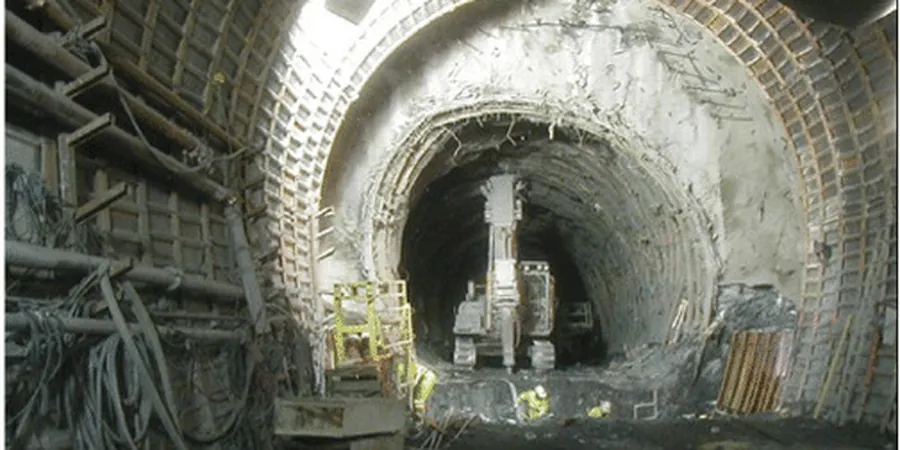
Technical reference image — Wexford

Local considerations

IS EN 1997-1:2005 (Eurocode 7) requires that tunnel design in soft ground explicitly address face instability, excessive settlement, and buoyancy during construction. Wexford's proximity to the Slaney estuary introduces a tidal influence on groundwater levels that fluctuates by up to 2 metres daily, meaning pore pressure regimes are never static. The most severe risk is a face collapse triggered by undrained failure when advance rate is too slow; the remoulded strength of these sensitive clays can drop to less than 30% of the intact value. Our laboratory quantifies sensitivity (St) through fall-cone and triaxial reconsolidation procedures so the contractor can establish critical advance rates and required face pressure before mobilisation.

Need a geotechnical assessment?

Reply within 24h.

Email: contact@geotechnical-engineering.co

Technical parameters

ParameterTypical value
Undrained shear strength (su) from CIUC triaxialTypically 15–40 kPa in Slaney alluvium
Coefficient of consolidation (cv)0.5–5.0 m²/year, vertical and horizontal
Compression index (Cc)0.25–0.55 for soft silty clay
Secondary compression index (Cα)0.008–0.025 for organic silt
Permeability from triaxial flow tests1×10⁻⁹ to 1×10⁻⁷ m/s
Effective friction angle (φ') from CIUC25°–32°
Overconsolidation ratio (OCR)1.0–2.5 in near-surface deposits
Sensitivity (St)3–8 for post-glacial clays

Associated technical services

01

Advanced triaxial testing programme

CIUC and CAUC triaxial tests on undisturbed Shelby tube samples from the tunnel horizon, with full saturation and pore-pressure measurement to define the undrained strength envelope and effective stress parameters for face stability calculations.

02

Oedometer consolidation suite

Incremental loading oedometer tests measuring cv, Cc, and Cα on vertical and horizontal specimens to predict both primary and secondary settlement above the tunnel crown, critical for protecting Wexford's historic quay walls and bridge foundations.

03

Groundwater and permeability assessment

Triaxial permeability tests under back-pressure conditions combined with Atterberg limit determinations to correlate hydraulic conductivity with plasticity, supporting dewatering design and inflow estimates for the tidal zone.

Applicable standards

IS EN 1997-1:2005 + Irish National Annex (Eurocode 7: Geotechnical design), IS EN ISO 17892-9:2018 (Triaxial compression tests), IS EN ISO 17892-5:2017 (Oedometer consolidation), IS EN ISO 17892-4:2016 (Particle size distribution), IS EN ISO 14688-2:2018 (Soil classification for engineering purposes)

Frequently asked questions

How does soft-ground tunnelling analysis differ from standard site investigation in Wexford?

Standard site investigation often stops at SPT N-values and basic classification. For tunnelling, we need undisturbed samples for triaxial and oedometer testing because the stress path around a tunnel opening is fundamentally different from that under a footing. In Wexford's estuarine clays, the low undrained strength and high sensitivity mean that remoulding during sampling must be minimised; we specify thin-walled Shelby tubes pushed at a controlled rate. The laboratory programme includes CIUC triaxial tests at confining stresses matching the in-situ effective stress at tunnel depth, plus oedometer tests that run for a full 24 hours per increment to capture secondary compression, which governs long-term settlement of the tunnel lining.

What is the typical cost range for a geotechnical analysis programme for a soft soil tunnel in Wexford?

A comprehensive laboratory programme, including triaxial and oedometer testing on samples from 3 to 5 boreholes along a tunnel alignment in Wexford, generally falls between €4,140 and €15,600 depending on the number of specimens, depth intervals tested, and whether groundwater chemistry or advanced consolidation analysis is required. This covers sampling supervision, specimen preparation, testing cycles, and the interpretative report with design parameters ready for the tunnel engineer.

Can you test the sensitivity of the soft clays found under Wexford town?

Yes, sensitivity testing is a standard part of our soft-ground tunnel programme. We measure intact undrained shear strength on pristine specimens in the triaxial cell, then remould the same material at the same water content and re-test using the laboratory vane or fall-cone method. The ratio of intact to remoulded strength gives the sensitivity. In Wexford, values between 3 and 8 are typical for the post-glacial silty clays, but pockets of organic silt near the harbour can exceed 10. This matters because a sensitive clay loses most of its strength if disturbed by an advancing TBM or excessive face movement.
Location and service area

We serve projects across Wexford and its metropolitan area.

View larger map