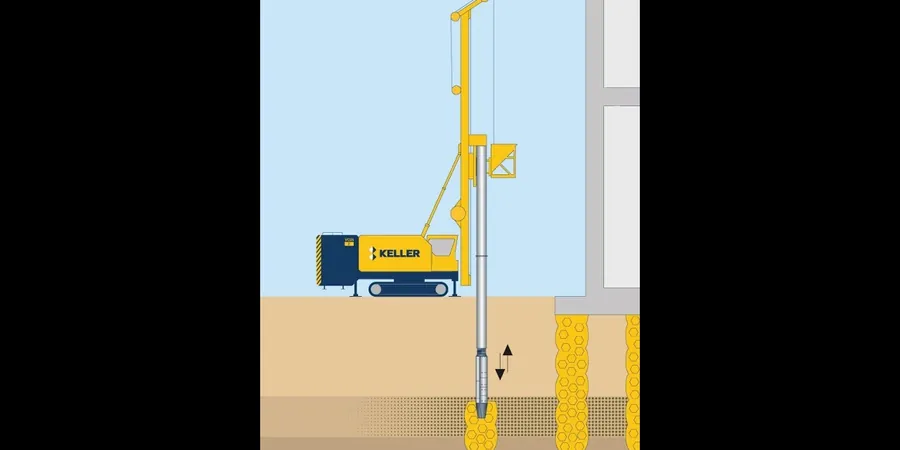
The depth vibrator arrives on a tracked carrier, its cylindrical probe extending up to 15 metres below grade while water jets or compressed air assist penetration. In Wexford, where glacial outwash sands and estuarine silts dominate the subsurface profile, the machine’s eccentric weight assembly generates horizontal oscillations that rearrange loose grains into a denser matrix. The town sits at the mouth of the Slaney River, with alluvial deposits that extend across much of the commercial and residential development zones south of the N11. Each compaction point follows a triangular or square grid, with spacing derived from in-situ relative density targets and the vibrator’s influence radius. For sites where the granular layer is interbedded with softer lenses, the design may incorporate a stone column transition zone to bridge the stiffness contrast before the vibrocompaction grid begins.
Achieving 70% relative density in Wexford’s estuarine sands requires probe spacing tighter than the textbook charts suggest—site-specific calibration is non-negotiable.
Methodology and scope
Wexford’s mean elevation of roughly 20 metres above sea level belies the complexity of its near-surface geology: raised beach deposits, glacial tills, and estuarine alluvium alternate within short distances, creating a patchwork of relative densities that can vary from 35% to 70% across a single site. The vibrocompaction design process begins with CPT or SPT soundings mapped onto a relative density profile, identifying zones below the 55% threshold that would settle excessively under structural or seismic loading. Probe spacing is then calibrated using the influence factor method: a 130 kW vibrator operating at 30 Hz may achieve a compaction radius of 1.8 to 2.4 metres in clean sands, but that radius contracts in silty sands typical of Wexford’s estuarine fringe. Treatment depth rarely exceeds 12 metres here, constrained by the depth to bedrock in the Rosslare Complex, which underlies much of the county at accessible elevations. The design package includes a grid layout, stage-by-stage withdrawal rates, hold-time at each depth increment, and a verification protocol using post-treatment CPT correlations.
Frequently asked questions
What ground conditions in Wexford are suitable for vibrocompaction?
Vibrocompaction works best in granular soils with a fines content below 12–15% and a coefficient of uniformity greater than 2. In Wexford, the raised beach sands and glacial outwash deposits south of the Slaney typically meet these criteria, though the estuarine silts near the quays often require a hybrid approach. A CPT-based soil behaviour type classification is the first step in determining suitability.
How long does a vibrocompaction design take to prepare?
A full design package—from receiving the ground investigation data to issuing the treatment specification and grid layout—typically requires 8 to 12 working days. Sites with complex stratigraphy, such as those in Wexford’s harbour area where tidal influence affects groundwater, may need additional time for sensitivity analysis of the compaction parameters.
What is the typical cost range for vibrocompaction design in Wexford?
Design fees for vibrocompaction in the Wexford area generally range from €1,340 to €4,910, depending on treatment area size, number of CPT soundings to be interpreted, and whether post-treatment verification specification is included. Sites under 1,500 m² with straightforward stratigraphy fall toward the lower end; multi-zone designs with seismic performance criteria fall toward the upper end.
Can vibrocompaction replace deep foundations in Wexford?
In granular profiles where densification can raise the allowable bearing pressure to 200–300 kPa, vibrocompaction often eliminates the need for piles beneath lightly to moderately loaded structures. The decision hinges on the post-treatment modulus: a design that achieves a constrained modulus above 40 MPa in the upper 6 metres can support spread footings where piles would otherwise have been specified.