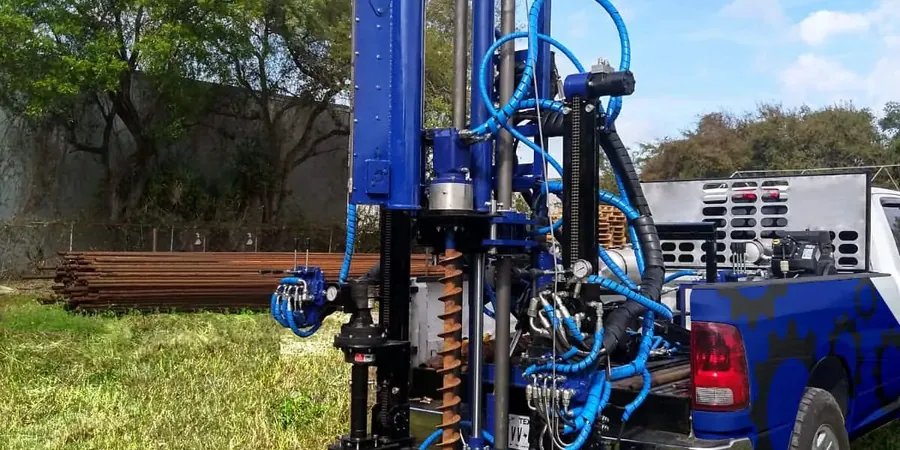
Wexford's subsurface tells a complicated story. Much of the town centre sits on glacial till left behind by the last ice age, while areas closer to the Slaney estuary transition into soft estuarine silts and clays with organic layers that can extend beyond 5 metres depth. We have hit refusal on weathered Ordovician slate at less than 4 metres near the quays and driven past 15 metres through loose sands out toward Rosslare. The SPT gives us that direct answer every time. In our experience across the county, combining the Standard Penetration Test with careful logging of cuttings tells you more about Wexford ground than any desktop study ever will. The split-spoon sampler recovers a disturbed but tangible sample, and the blow count — whether it's 4 or 40 — immediately flags where the bearing capacity drops or where pile refusal depth sits.
An SPT N-value of 4 in Wexford estuarine clay versus 35 in the glacial till tells you everything you need to know about where your foundation should bear.
Methodology and scope
The contrast between a site on the north side of Wexford town and one down near Ferrybank can be stark. North of the N25 you are typically into dense lodgement till — grey, stony, and stiff, with SPT N-values often exceeding 30 within the first couple of metres. Cross the bridge toward the south bank and the profile changes to interbedded silts and soft clays where N-values of 3 to 8 are common down to 7 or 8 metres before any competent stratum appears. We run the SPT at 1.5-metre intervals as standard, but tighten the spacing through transitional layers because missing a thin soft seam under a stiff crust has caused foundation problems in more than one Wexford building we have investigated. Every test follows IS EN ISO 22476-3, and we use an automatic trip hammer calibrated to 60% energy efficiency so the N60 values are directly usable for liquefaction assessment and bearing capacity calculations without guesswork corrections.
Frequently asked questions
How much does an SPT borehole cost in Wexford?
For a single SPT borehole with standard 1.5-metre test intervals, logging, and a factual report, the cost in Wexford typically falls between €470 and €770 plus VAT, depending on depth, access conditions, and whether we encounter rock requiring coring. Sites with difficult access — for example rear gardens in the town centre with no machine access — sit at the upper end of the range because of the extra setup time and hand-clearing required.
How deep do you need to drill for a house foundation in Wexford?
For a typical two-storey house on the glacial till north of the N25, 6 to 8 metres is usually sufficient to prove competent bearing strata. On softer ground near the Slaney or in the Rosslare area where sands and silts extend deeper, we often recommend 10 to 15 metres. The key is reaching a stratum with SPT N-values above 15 and confirming it extends at least 2 metres below the proposed foundation level.
What is the difference between SPT and a trial pit investigation?
A trial pit lets you see the soil fabric in situ but is limited to about 4.5 metres depth in Wexford before shoring becomes mandatory. The SPT goes much deeper — we routinely drill to 15 or 20 metres — and gives you a numeric blow count at each test depth that you can use directly in Eurocode 7 design calculations. We often use both methods together: trial pits for near-surface characterisation and SPT boreholes for the deeper profile.
How long does an SPT investigation take on a Wexford site?
A single borehole to 10 metres on accessible ground can be completed and logged in one working day. Deeper holes, multiple locations, or sites where we need to core through rock add time. The factual report with N-value plots and soil descriptions is typically delivered within five to seven working days after fieldwork finishes.