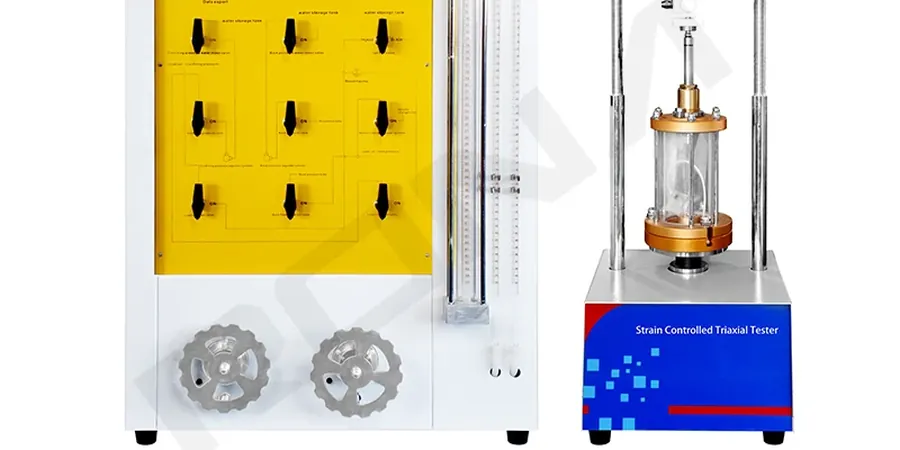
The ground conditions across County Wexford tell a story of retreating ice sheets and rising seas. From the boulder clays that mantle the uplands around Enniscorthy to the soft alluvial silts underlying Wexford Town's quayfront, the soil profile is rarely straightforward. What looks like a competent till can hold perched water tables that saturate without warning, and the estuarine clays along the Slaney can lose half their strength when remoulded. In our experience, a standard penetration test alone cannot resolve the effective stress parameters needed for safe foundation design here. A triaxial test programme, run under consolidated undrained conditions with pore pressure measurement, gives the design team the friction angle and cohesion intercept that reflect true in-situ behaviour, not an empirical correlation. For road embankments and wind farm access tracks, combining triaxial data with CBR road testing provides a complete picture of both strength and stiffness under repeated loading.
Effective stress parameters from a triaxial test can reduce foundation concrete by 15 to 20 percent compared to total stress assumptions from field vanes alone.
Methodology and scope
The equipment we deploy for Wexford projects is a servo-controlled triaxial cell capable of confining pressures up to 1.7 MPa, which covers the stress range typical of shallow to intermediate foundations in the region. A typical setup begins with trimming a 100 mm diameter Shelby tube sample onto the pedestal inside a temperature-controlled water bath, kept at the ambient groundwater temperature measured in the field, usually 10 to 12 degrees Celsius across the county. We saturate the specimen using a back-pressure ramp while monitoring Skempton's B-value; anything below 0.95 means incomplete saturation, and we see that often with the stiff, fissured tills north of Gorey. Drainage is controlled through high-entry ceramic discs, and pore pressure transducers record the response during the shear stage at a rate slow enough to allow equalisation. The stress path output, mapped into q-p' space, reveals whether the soil contracts or dilates as it approaches failure, a distinction that determines whether a
footing design should use drained or undrained parameters. Every test runs under the procedures laid out in IS EN ISO 17892-9:2018, and the electronic data files are archived with full metadata, including specimen density and saturation history.
Local considerations
IS EN 1997-2:2007 requires that the selection of characteristic soil parameters account for the influence of sampling disturbance and test method. In Wexford's lacustrine clays, which can exhibit sensitivities above 8, tube sampling alone can reduce undrained shear strength by 20 to 30 percent compared to block samples. A single UU triaxial on a disturbed specimen will underestimate the true strength, leading to oversized, costly foundations. The bigger risk, however, is misclassifying a drained failure as undrained. The sandy silt lenses common in the Screen Formation drain rapidly enough that an embankment loading over several weeks will dissipate excess pore pressure, meaning the effective stress friction angle from a CU test with pore pressure measurement controls stability, not the undrained strength. Ignoring this distinction has caused slope failures on the N11 upgrade where designers used vane shear data without triaxial verification. Our laboratory protocols require three specimens per formation, tested at confining pressures that bracket the in-situ stress range, so the Mohr-Coulomb envelope is defined by data points, not a single extrapolation.
Frequently asked questions
What is the typical turnaround time for a triaxial test programme in Wexford?
A standard three-specimen CU test programme with pore pressure measurement, from specimen extrusion to the final interpretive report, takes 12 to 15 working days. The consolidation stage alone requires 24 to 48 hours per specimen for the low-permeability clays common in County Wexford. If a project is on a tight schedule, we can issue preliminary effective stress parameters as each specimen completes shear, ahead of the full report.
Which triaxial test type is most appropriate for the boulder clays around Wexford Town?
For the stiff, overconsolidated boulder clays, a consolidated drained (CD) test or a CU test with pore pressure measurement are both suitable. The CD test directly measures the drained friction angle, which governs long-term stability. However, the test duration can extend to several weeks due to the low permeability. A CU test with pore pressure measurement provides the effective stress envelope in a shorter timeframe and is the more common choice for commercial and residential foundation design in the region.
How much does triaxial testing cost for a site investigation in County Wexford?
A full triaxial programme, including three CU specimens with pore pressure measurement, consolidation data, and a factual interpretive report, typically ranges from €1,650 to €2,180. The exact cost depends on the number of specimens, the required confining stress range, and whether multi-stage testing is needed to conserve samples. All testing is performed in our INAB-accredited laboratory to IS EN ISO 17892-9.
Can you test samples taken from trial pits, or do you need borehole cores?
We can test undisturbed block samples carefully trimmed from trial pit excavations, and these often yield higher-quality specimens than driven tube samples, especially in the stony tills found north of Enniscorthy. The sample must be sealed in wax and transported in a rigid container to prevent moisture loss and vibration damage. For softer clays below the water table, thin-walled Shelby tubes advanced from a borehole are the more practical sampling method.