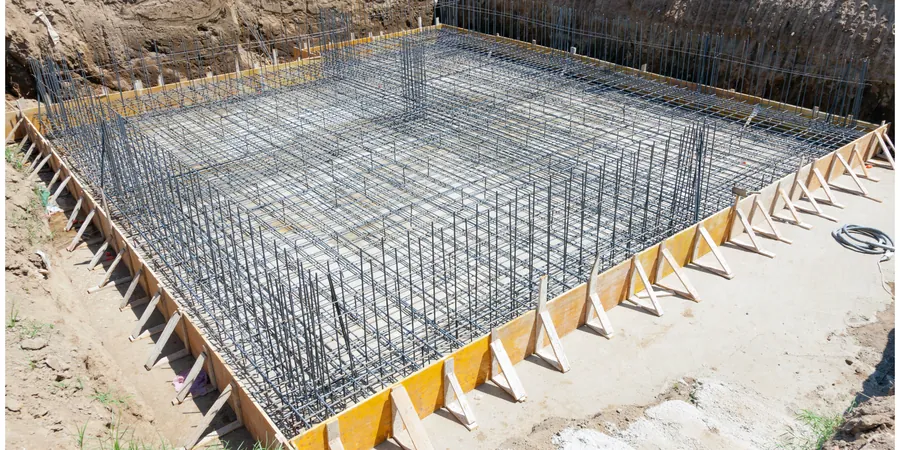
Building near Wexford Harbour demands a different approach than constructing on the elevated drumlins north of town. The quayside sits on soft estuarine silts that compress under load, while areas toward Barntown rest on dense glacial till that can handle higher bearing pressures. A raft foundation bridges these extremes by spreading structural loads across a continuous slab, reducing differential settlement. We design mat foundations sized to the actual ground profile under your site, not a generic assumption. Before finalizing slab geometry, we often run SPT drilling to map refusal depth and correlate N-values with stiffness, giving the structural engineer a reliable subgrade reaction modulus for the FEM model.
A properly designed mat foundation turns variable Wexford soils into a predictable working platform, cutting differential settlement to within millimetres across the slab.
Methodology and scope
Wexford's Quaternary geology is dominated by late-glacial tills overlying shale and slate bedrock, but the Slaney River corridor introduces deep pockets of compressible alluvium. Groundwater can sit within 1.5 metres of surface in low-lying commercial zones, which complicates mat foundation performance if not drained. Every design we produce accounts for seasonal water table fluctuation and its effect on bearing capacity reduction. Key engineering steps in a typical Wexford raft project include:
• Geotechnical characterization of the upper 4 to 8 metres via boreholes and CPT soundings
• Assessment of long-term consolidation settlement under sustained dead load
• Iterative slab thickness optimization against punching shear at column locations
• Verification of frost protection depth per Irish Building Regulations Technical Guidance Document C
For sites with marginal upper strata, we integrate
stone columns as ground improvement beneath the mat to accelerate drainage and stiffen the composite foundation, reducing total settlement by 30 to 50 percent.
Frequently asked questions
What does a raft foundation design cost for a Wexford commercial building?
Design fees for a standalone commercial raft foundation in County Wexford typically range from €960 for a small single-storey extension on straightforward ground to €3,900 for a multi-storey structure requiring full FEM analysis, settlement modelling, and construction-phase QA documentation. The final figure depends on slab area, number of column points, and whether ground improvement like stone columns is included in the scope.
When is a raft foundation better than strip footings in Wexford?
A raft becomes the better choice when the allowable bearing pressure drops below 75 kPa, when strip footings would cover more than 50 percent of the building footprint, or when differential settlement between columns must stay under 10 mm. Wexford's quayside alluvium and reclaimed ground near the harbour almost always favour a raft solution over isolated pads.
How do you verify the subgrade under a raft slab before the concrete pour?
We specify plate load tests on the prepared formation level, typically one test per 200 m² of slab area. The load-settlement curve is measured up to twice the design bearing pressure and compared against the modulus of subgrade reaction assumed in the FEM model. Any soft spots identified during the proof-rolling stage are excavated and replaced with compacted crushed rock before retesting.